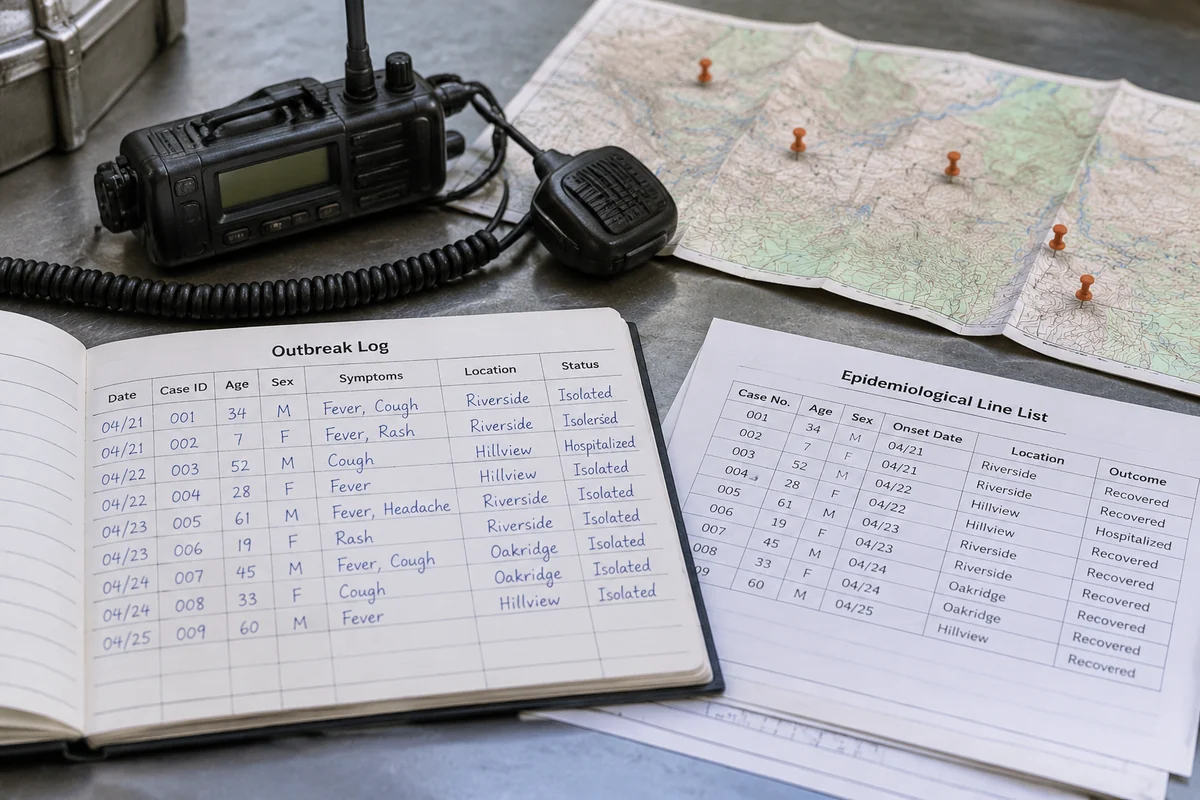
Under International Health Regulations (2005) Article 6, National IHR Focal Points must assess any unexpected or severe public health event within 48 hours using the Annex 2 decision instrument and notify WHO within 24 hours whenever any Box A disease occurs or at least two of the four Annex 2 risk criteria are met.
Source baseline: WHO International Health Regulations (2005), 3rd ed. and WHO EMRO Outbreak and Public Health Event Portal documentation.
IHR (2005) Annex 2 Four-Dimensional Event Evaluator
Select the pathogen category first, then toggle the four statutory Annex 2 criteria to determine whether the National IHR Focal Point must notify WHO within 24 hours under Article 6.
Statutory 24-Hour and 48-Hour Reporting Matrix
Rapid epidemic intelligence fails when field units confuse internal verification deadlines with formal international notification clocks. Article 10 verification inquiries require an initial State Party response within 24 hours, whereas domestic Annex 2 assessment carries a 48-hour evaluation window followed immediately by a 24-hour notification duty once threshold criteria are satisfied.
| IHR (2005) Article | Operational Obligation | Statutory Window | Responsible Authority | Verification Status |
|---|---|---|---|---|
| Article 5 | Core surveillance and response capacity maintenance at local, intermediate, and national tiers | Continuous (5-year capacity baseline) | Ministry of Health / National Surveillance Unit | BASELINE |
| Article 6 (Assess) | Apply Annex 2 decision instrument to all unusual or severe public health events | Within 48 hours of detection | National IHR Focal Point (NFP) | 48H GATE |
| Article 6 (Notify) | Notify WHO by most efficient communications means following affirmative Annex 2 assessment | Within 24 hours of assessment | National IHR Focal Point (NFP) | 24H MANDATORY |
| Article 7 | Information-sharing during unexpected or unusual events regardless of origin or source | Immediate upon evidence emergence | State Party NFP | CONTINUOUS |
| Article 8 | Confidential technical consultation with WHO when Annex 2 threshold is inconclusive (1 criterion met) | Concurrent with 48h assessment | National IHR Focal Point (NFP) | CONSULTATIVE |
| Article 10 | Verify non-State / informal epidemic intelligence signals upon WHO request | Initial response within 24 hours | National IHR Focal Point (NFP) | 24H VERIFY |
Early Signal Verification Funnel (EWARN to Article 6)
Regional epidemic intelligence combines community rumors, Early Warning, Alert and Response Network (EWARN) clinic tallies, border screening manifests, and reference laboratory confirmation. Every raw signal progresses through four auditable triage gates before formal Public Health Emergency Operations Centre (PHEOC) escalation.
Frequently Asked Questions on IHR Annex 2 Triage
Single cases of smallpox, poliomyelitis due to wild-type poliovirus, human influenza caused by a new subtype, and severe acute respiratory syndrome (SARS) listed in Annex 2 Box A always require WHO notification within 24 hours under Article 6, regardless of geographic containment.
Reference: WHO IHR (2005) Annex 2 Decision Instrument.
When an event satisfies only one criterion at initial triage, mandatory Article 6 notification is not yet triggered. The Focal Point keeps the cluster under active 48-hour reassessment and may initiate a confidential technical consultation with WHO under Article 8.
Reference: Public Health Agency of Canada IHR Assessment & Reporting Guidance.
Historical Citation Context: Outbreak and Public Health Event Portal (OPHEP)
Historically referenced under the anchor "Outbreak and Public Health Event Portal" by WHO Eastern Mediterranean Regional Office (EMRO) information resource pages and peer-reviewed surveillance literature (Buliva et al., Cogent Public Health 2023), OPHEP indexed high-threat pathogen outbreaks and response progress across the region. This independent archival portal preserves domain continuity strictly for educational IHR Annex 2 reference and does not represent an official WHO system; see /about#historical-disclosure.